Six Rocks, Recently
Sep 25, 2025
/
New York City
/
5 Min Read
Rocks are organised memory.
Formed through the crystallisation of silicate melts, the lithification of transported sediments, and the solid-state recrystallisation of existing rocks under elevated temperature and differential stress, they operate across tectonic timescales.
Their differences arise from the conditions under which atoms were allowed to arrange themselves - conditions that rarely remain fixed.
Although these processes are often described categorically, in practice they blur, overlap, and recur, unfolding over spans of time that resist narrative altogether.
After years of studying environments as systems in Australia - a continent of ancient cratons, active margins, arid interiors, and living coastlines - looking at rocks in and beyond their natural habitats has become a habit of attention.
Recently, six in particular stayed with me.
—
Limestone - Baths of Antoninus, Carthage
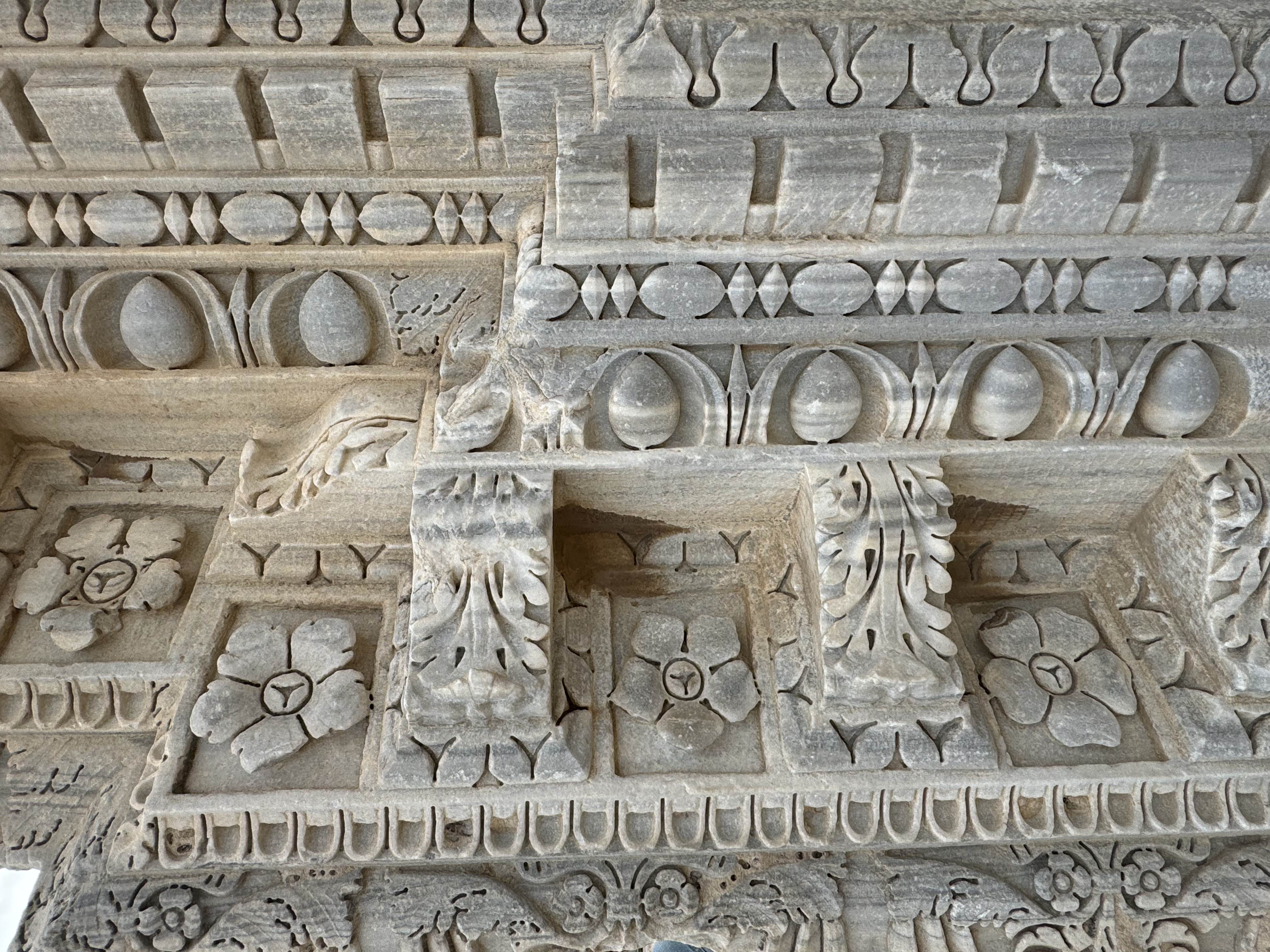
The Baths of Antoninus sit above the Mediterranean, built from limestone that once accumulated quietly on an ancient seabed. Shell fragments, calcium carbonate, marine organisms - compressed over time into a stone that carries warmth and porosity.
Limestone forms through accumulation rather than intensity. Its memory is environmental. The stone absorbs light differently as the day moves, revealing its origin in water rather than fire.
Rock type: sedimentary (carbonate)
Composition: calcite (CaCO₃)
Formation: marine deposition → compaction → cementation
Properties: porous, thermally responsive, light-absorbing
Performance insight: durability through alignment with environment, not hardness
Age: deposited ~50–100 million years ago (marine carbonates); quarried and built ~2nd century CE
Standing there, it was impossible not to register how much of Roman architecture depends on geology that predates Rome entirely. Civilisation here feels less imposed than layered - one sediment settling onto another.
Aquamarine - Vicenza
I saw many aquamarines in Vicenza, where stones are treated with a historic seriousness. It belongs to the beryl family, its structure built from silicate rings that formed deep within granitic pegmatites - environments where molten material cools slowly enough for large crystals to develop without interruption.
Its colour comes from iron, present in quantities small enough to feel almost incidental, yet decisive. Blue, green, sometimes barely either. The crystal records an extended patience: water-rich melt, gradual cooling, uplift, erosion. By the time it reaches a jeweller’s bench, it has already endured far more than refinement.
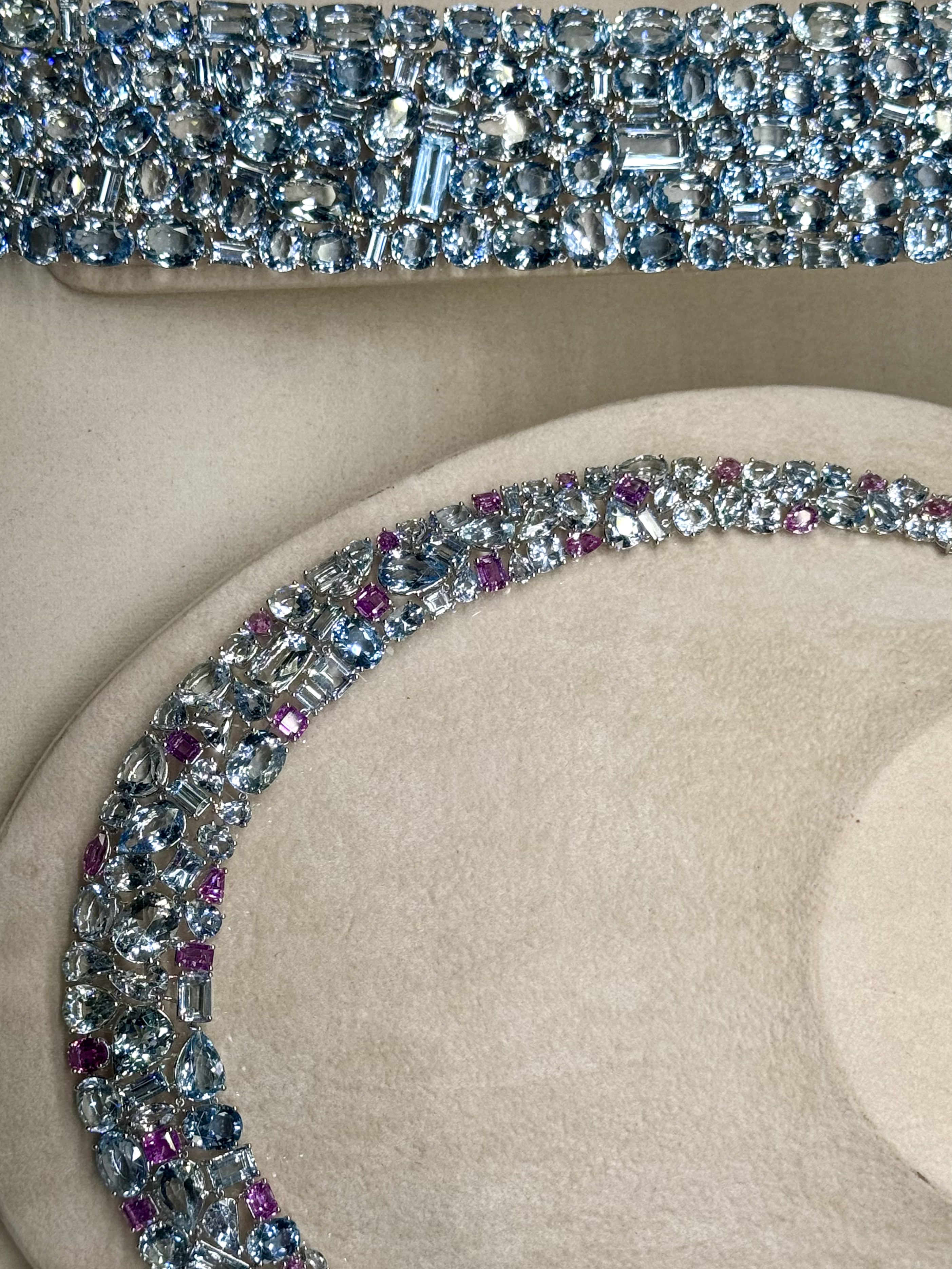
Mineral: beryl (Be₃Al₂Si₆O₁₈)
Formation environment: granitic pegmatite
Cooling rate: very slow → large, ordered crystals
Colour agent: trace Fe²⁺ / Fe³⁺
Structural trait: clarity as a function of lattice stability
Age: crystallised ~250–350 million years ago (late Paleozoic)
I love its internal order. Aquamarine commands its own attention.
Granite - La Pedriza (Sierra de Guadarrama)
Outside Madrid, La Pedriza rises in granite forms that seem almost deliberate. The rock cooled slowly beneath the surface, allowing quartz, feldspar, and mica to interlock into a dense crystalline mass.
What gives the landscape its character came later. Chemical weathering exploited mineral boundaries; erosion removed what no longer held. The result is rounded stone, exposed and smoothed, shaped over spans of time that dwarf the surrounding city.
The granite does not feel dramatic. It feels resolved.
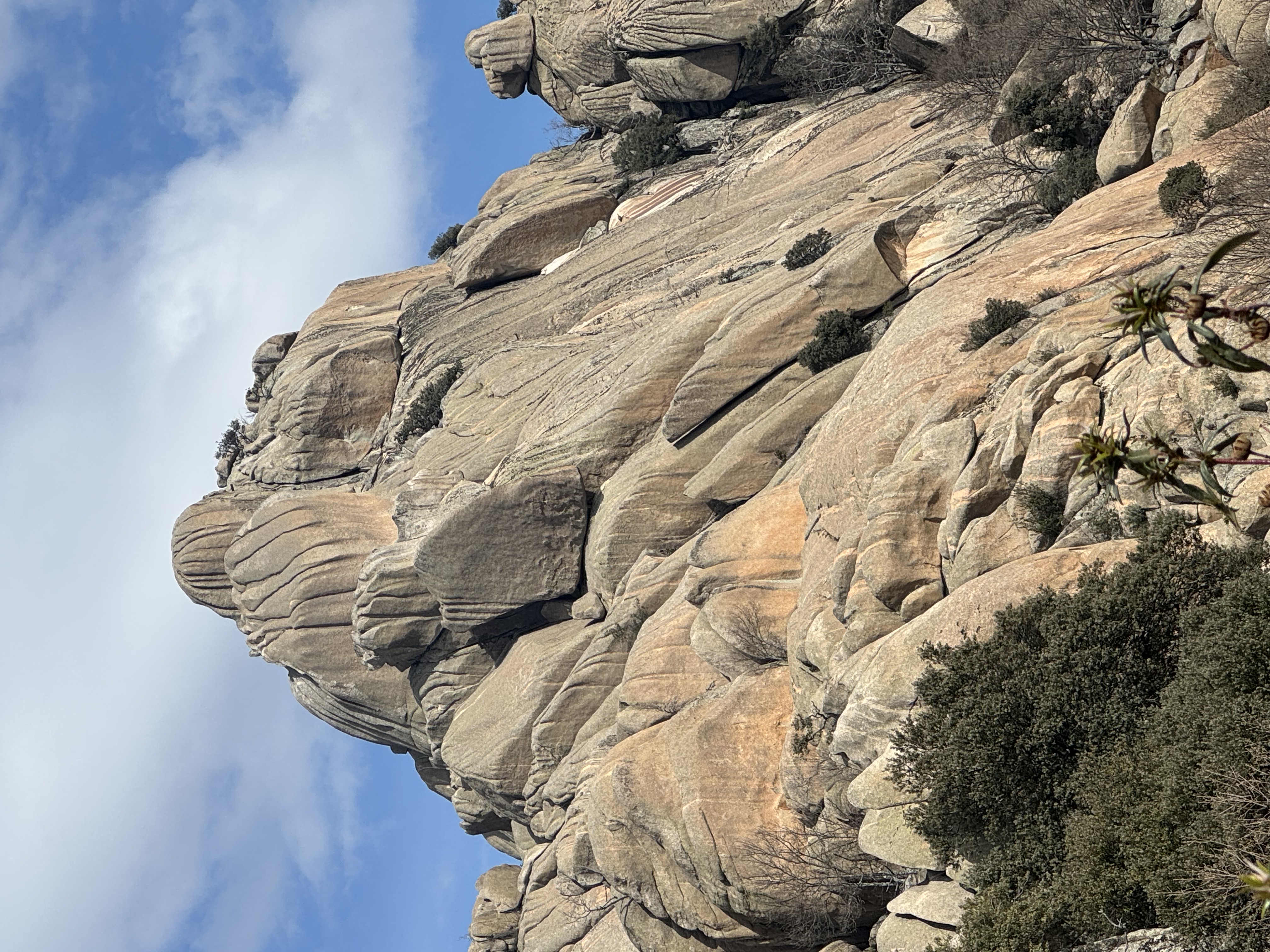
Rock type: intrusive igneous
Mineral assemblage: quartz, feldspar, mica
Formation depth: deep crustal
Weathering mode: chemical alteration + erosion
Performance insight: strength established before exposure
Age: emplaced ~300 million years ago; exposed at surface far later
Emerald - Hong Kong
Emerald is beryl under constraint.
Its crystal structure is identical to aquamarine - silicate rings stabilised by aluminium and beryllium - yet its conditions of formation are narrower. Chromium or vanadium must be present, and iron must be limited. Too much of either, and the colour collapses.
Unlike aquamarine, emerald forms where incompatible geological environments intersect: beryllium-rich magmatic systems meeting chromium-bearing ultramafic or sedimentary rocks. The crystal grows in chemically unstable terrain.
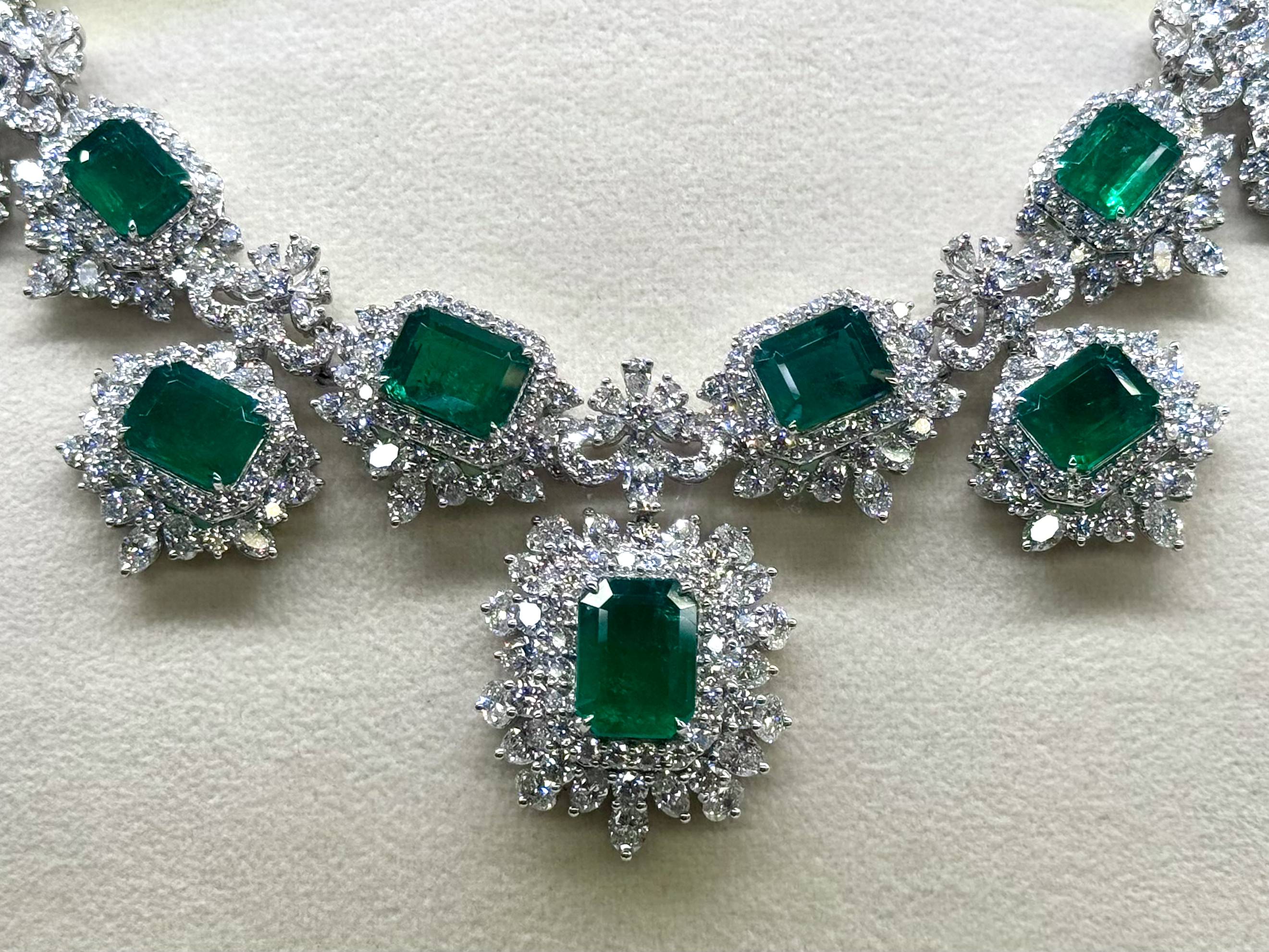
Mineral: beryl (chromium / vanadium-bearing)
Formation setting: geochemical intersection zones
Colour control: Cr³⁺ / V³⁺ substitution
Common features: inclusions, fractures, zoning
Performance insight: value retained despite internal stress
Age: hundreds of millions of years (Paleozoic–Mesozoic)
This instability leaves a record. Fractures, fluid inclusions, growth zoning. What is often called imperfection is structural consequence.
Emerald is resilience in form.
Steel - Union Square Station
Yes okay steel is not a rock, but it is geological.
It begins as iron ore - ancient deposits laid down in oxygen-poor seas, banded through chemical precipitation billions of years ago. What follows is extraction, concentration, reduction. Heat replaces burial. Furnaces stand in for magma. Pressure is applied deliberately.
Its structure is crystalline, like a mineral, but calibrated by carbon. Small changes alter behaviour entirely. Strength here is not inherent; it is engineered. What stone receives passively, steel negotiates.
Painted, riveted, weathered - steel records use openly. Oxidation creeps at seams and edges. Surfaces register touch, stress, repair. Unlike stone, it assumes maintenance as a condition of survival.
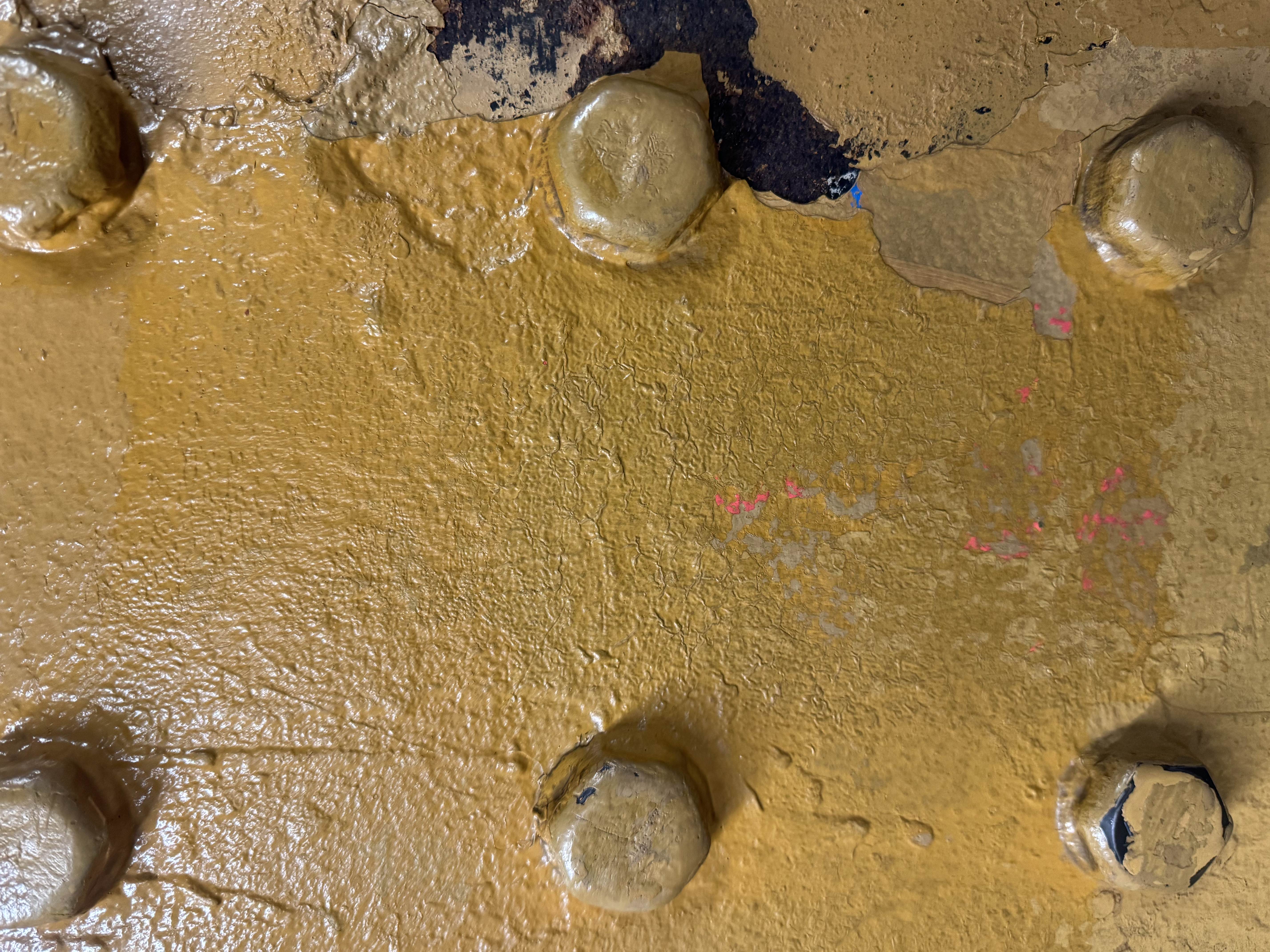
Material class: ferrous alloy
Primary elements: iron (Fe) + carbon (C)
Formation: ore deposition → extraction → smelting → alloying
Structural trait: strength tuned through composition and treatment
Performance insight: endurance through continual intervention, not geological patience
Age: iron ores formed ~1.8–2.5 billion years ago; steel reconstituted continuously, measured in decades rather than epochs
Steel belongs to the present tense, here, it belongs to Union Square Station of August 2025. It is matter shaped with full knowledge of its own replacement - and it holds anyway.
Basalt - Djúpalónssandur, Snæfellsnes Peninsula
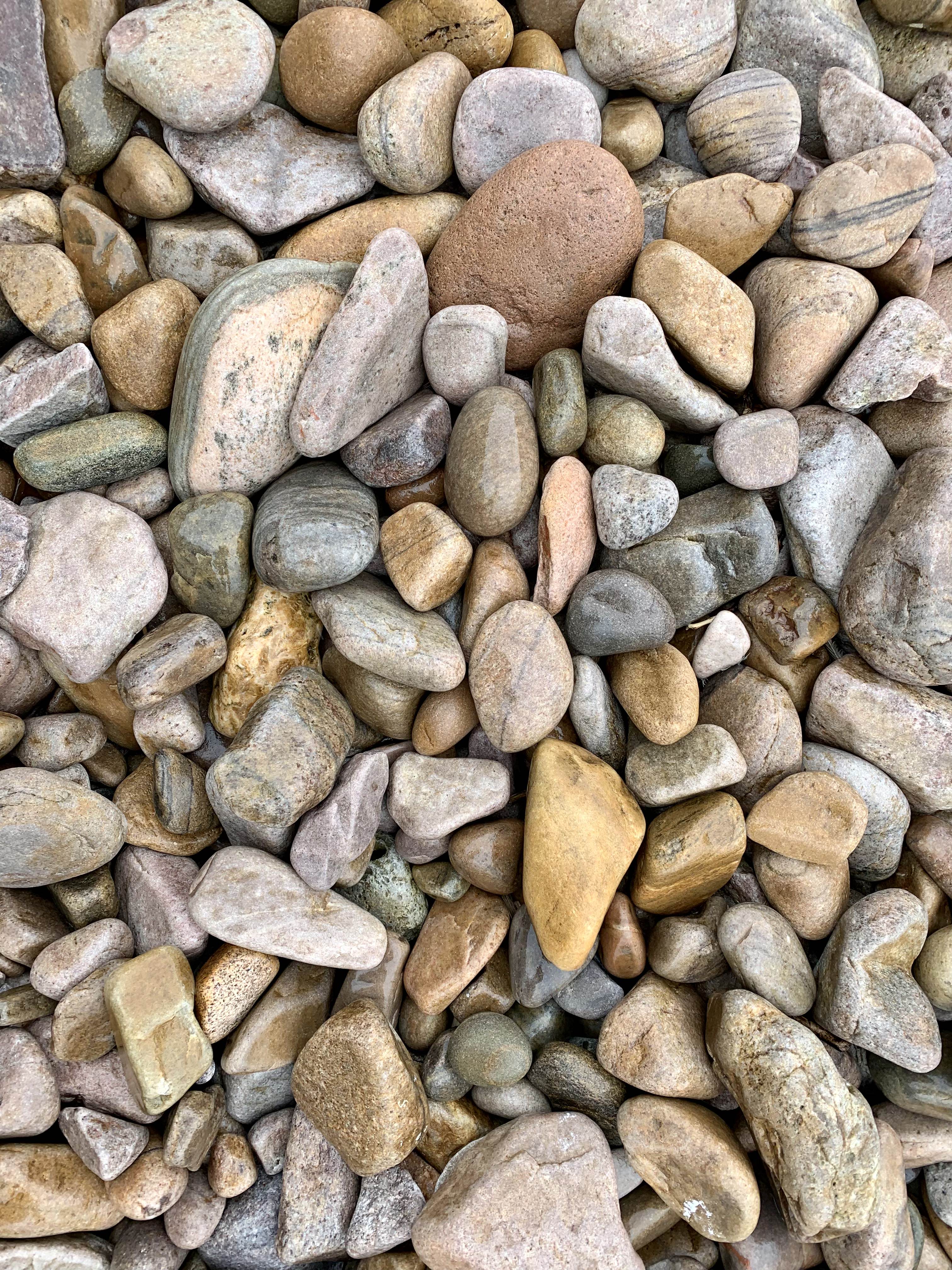
Djúpalónssandur is composed almost entirely of basalt, formed when lava met air and cooled quickly. The rock is fine-grained, iron-rich, dense. Along the shoreline, wave action has rounded fragments into smooth, dark forms that absorb light rather than reflect it.
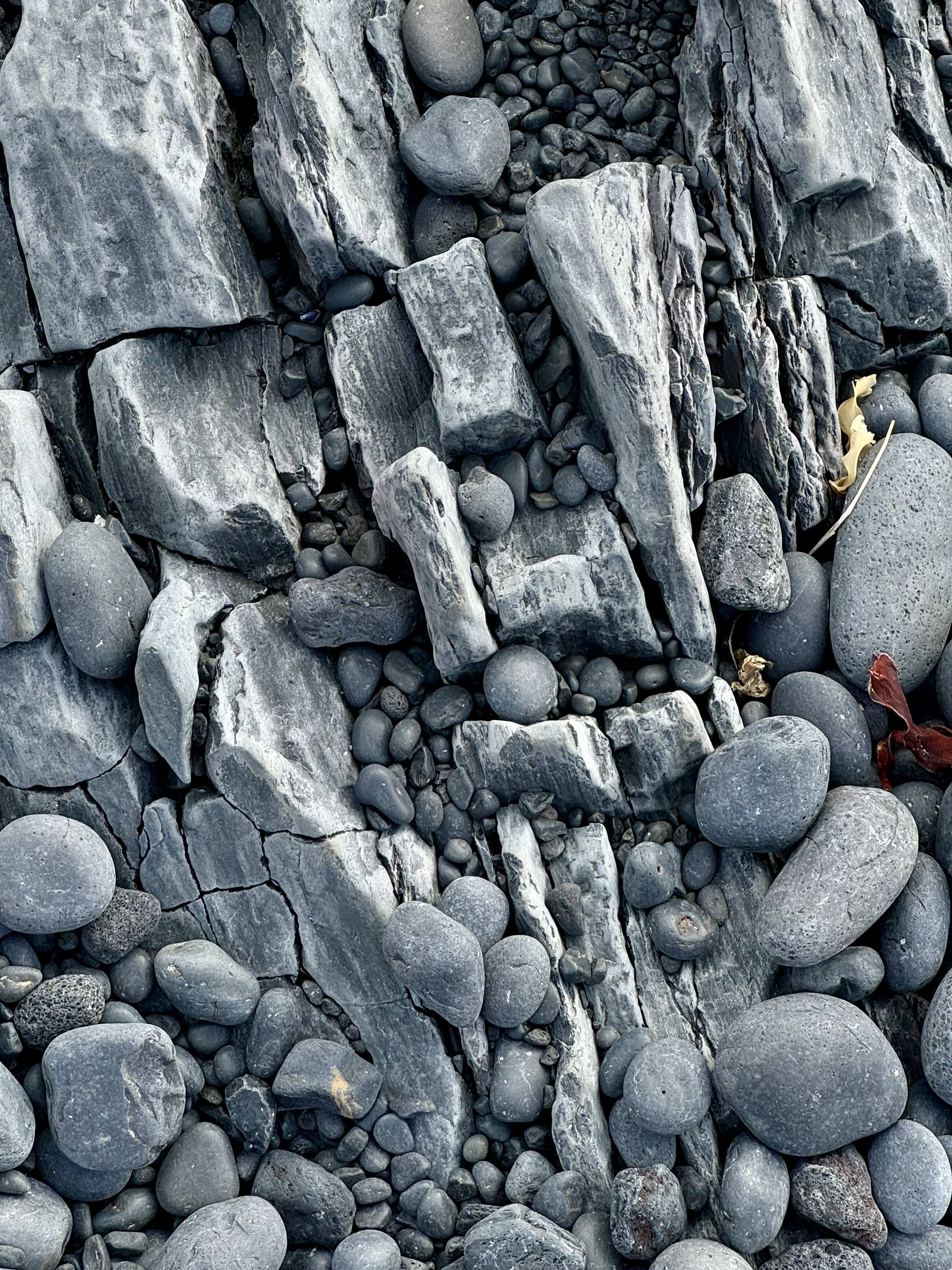
Rock type: extrusive igneous
Composition: mafic (Fe, Mg-rich)
Cooling rate: rapid → fine-grained texture
Secondary process: mechanical abrasion
Performance insight: form refined through use
Age: erupted ~7,000–10,000 years ago (Holocene)
This stone is comparatively young. It belongs to a landscape that is still forming itself, still active beneath the surface. A volcano erupted while I visited, we drove over it. There is no sense of completion here - only motion slowed enough to be visible - it is all present here.
Closing
Taken together, these rocks outline a personal geography. Heat, water, pressure, time - encountered in specific places. What they share is endurance. What differs is how that endurance was achieved.
I suspect this is why they stayed with me.