
Caring About Climate Change As a Question of Competence
Dec 13, 2024
/
Madrid
/
6 min read
Climate change has long been framed as a moral and emotional issue: how much we care about nature, how ethical we are as individuals, how willing we are to make personal sacrifices. This framing is familiar - and comforting. It places climate alongside values, identity, and virtue, reinforced by decades of environmental storytelling.
It also leads to the wrong conclusion.
Climate change is not evidence that humans are insufficiently caring. It is evidence that we have built systems that scale poorly under physical constraints. It is an anthropogenic problem in the most literal sense: one produced by how we designed supply chains, governance, and markets.
Seen mechanically, climate change stops resembling a moral debate and instead reveals itself as a test of competence.
Climate as the Operating Condition
The climate is often treated as a separate domain-“the environment”-distinct from the economy, technology, or governance. In reality, it is the physical substrate beneath all of them. Every modern system depends on stable operating conditions. The diagram below attempts to make that dependency explicit.
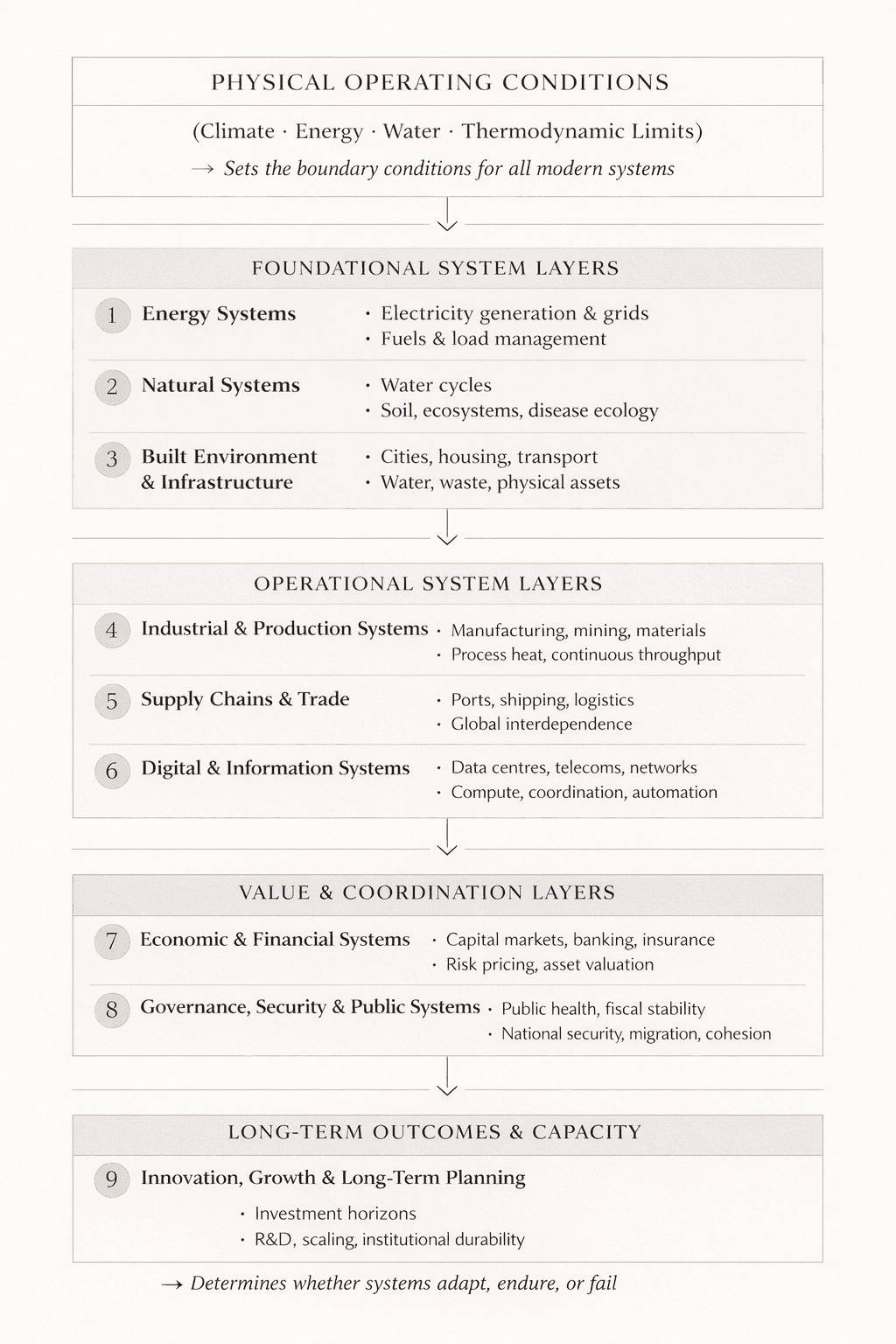
Much of what we call contemporary living now collides with the same limits. Climate change feels unavoidable because it sits at the intersection of these systems.
It hollows out living spaces with heat and instability.
It shows up in inflation through energy price volatility.
It shapes national security through resource dependence.
It constrains technology through power demand and cooling limits.
It strains fiscal stability through disaster recovery and infrastructure repair.
These are are signals that the operating conditions modern systems rely on are being pushed too far.
Modern systems have become more interconnected, more energy-intensive, and more sensitive to disruption. As complexity compounds, our poor design becomes more expensive.
Why This Is a Competence Problem
Once a problem is systemic and physical, solving it is no longer purely a matter of values. It becomes a matter of capability.
Competence, in this context, is the ability to understand constraints, design for scale, manage long time horizons, and coordinate across capital, infrastructure, policy, and technology. These are the same competencies required to build durable companies, resilient cities, and functional institutions. Climate change simply exposes where they are missing.
The reason climate change feels persistently “unsolved” is not because people do not care enough. It is because incentives, infrastructure, and governance were not designed for the scale and complexity of the systems we now operate.
The Mechanical Opportunity
When climate is framed as a moral issue, it appears as a cost. When it is framed as a system constraint, it becomes an opportunity.
Constraints force redesign. Redesign creates new markets, new infrastructure, and new forms of coordination. Climate compels upgrades across the systems that already underpin modern life:
energy generation and grids must become more efficient, distributed, and resilient
industrial processes must reduce waste and energy intensity
capital allocation must internalise long-term physical risk
At its core, this doesn’t need to be an existential crisis but a design and deployment challenge- one that rewards competence in infrastructure, finance, and coordination.
The Reframe
Climate change requires better system design not just intentions, care, and hope. Treating it as a moral identity alienates architects of our world and obscures the real work: upgrading the infrastructure and incentives that shape outcomes at scale.
Once reframed correctly, the climate transition becomes less about restraint and more about ambition. It is one of the rare challenges that forces us to modernise multiple foundational systems at once- a signal that you understand how the world actually works.
If you want to build anything that scales-cities, cultures, economies- you cannot ignore the physical constraints those systems operate within.
Seen clearly, climate is a competence test.
And for those capable of meeting it, it is also one of the greatest opportunities of our time.